
• About
  • Contact
  • Advertise
  • Subscribe
  • For Authors
  • Privacy Policy
  • Support the Behavioral Times
The Behavioral Times | Insights into the psychology of everyday behavior
  • About
  • Contact
  • Advertise
  • Subscribe
  • For Authors
  • Privacy Policy
  • Support the Behavioral Times
Advertisement
No Result
View All Result
  • About
  • Contact
  • Advertise
  • Subscribe
  • For Authors
  • Privacy Policy
  • Support the Behavioral Times
No Result
View All Result
The Behavioral Times | Insights into the psychology of everyday behavior
No Result
View All Result
Home Money & Behavior

Sadness and Shopping: Why We Spend More When We’re Sad

Florien Cramwinckel by Florien Cramwinckel
06/12/2025
in Money & Behavior
Reading Time: 6 mins read
0
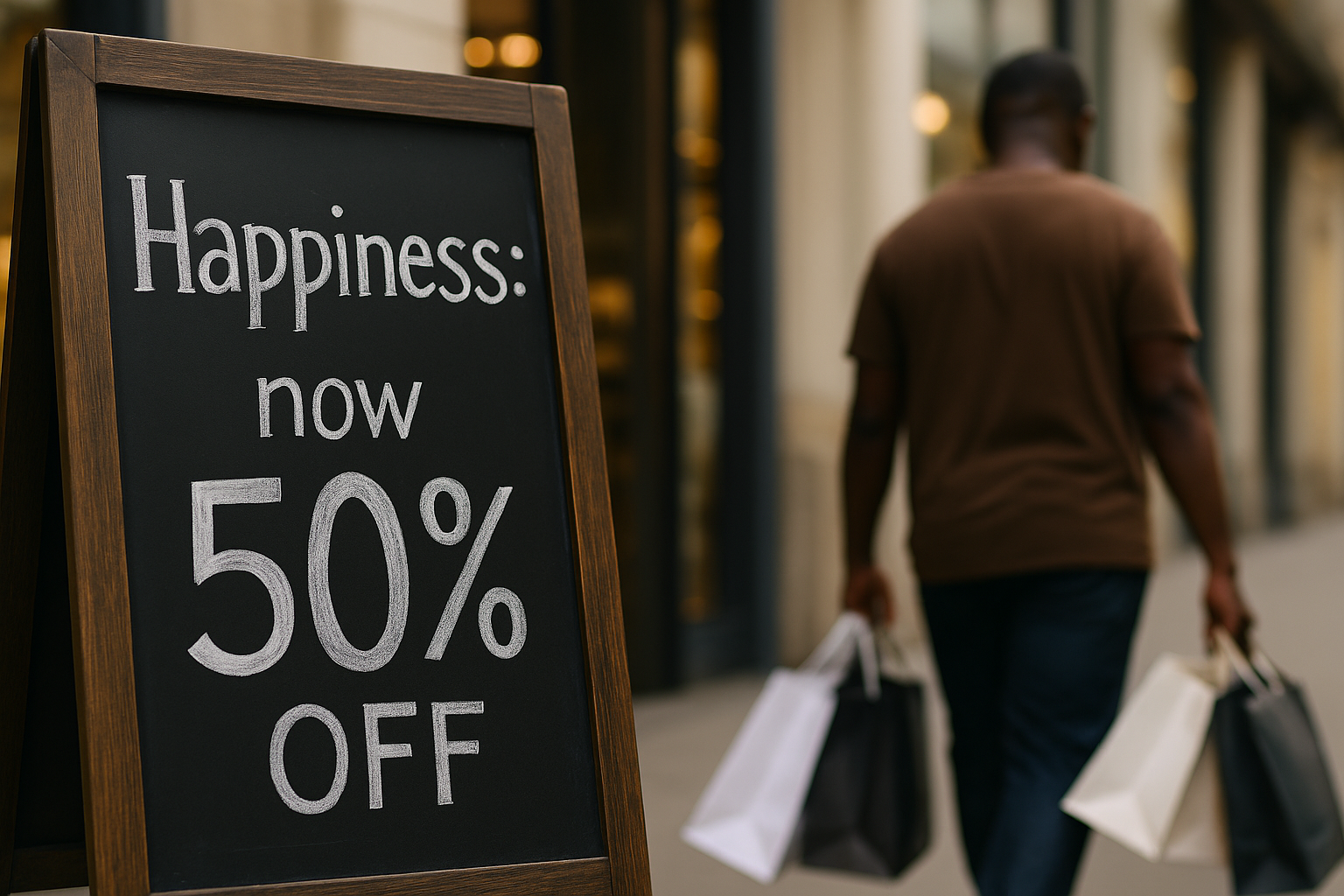
Man of color with shopping bags walking past a chalkboard sign saying “Happiness: now 50% off”
whatsapplinkedinemail

Sadness and shopping in everyday life

Imagine this: you’ve had a rough day — a failed project at work, a fight with a friend, or just one disappointment after another. Later that evening, you find yourself browsing online shops. You didn’t plan to buy anything, but suddenly that new pair of sneakers or fancy candle seems irresistible.

This experience is so common that it has its own name: retail therapy. But is it really therapy? Scientists have been studying the link between sadness and shopping. The surprising answer: sadness and shopping are deeply connected — and researchers have uncovered why.

📌 TL;DR

  • Sadness makes people spend more: research shows participants pay up to 30% more when sad.
  • The mechanism: sadness increases self-focus and lowers self-worth. Buying restores that sense of value.
  • Retail therapy works because making choices gives back a sense of control.
  • The effect is specific to sadness, not anger or other negative moods.
  • The relief is short-lived — and the bill remains.

Emotions and spending behavior

We like to think money decisions are rational, but in reality, emotions often drive them. Anger, for instance, tends to make people take more risks. Sadness, however, operates differently.

Instead of making us cautious, sadness actually increases our willingness to spend. Researchers call this the “misery is not miserly” effect — in plain English, being sad doesn’t make us tight-fisted; it makes us more willing to part with our money .

Why does this matter in daily life? Because sadness is inevitable — and if it pushes us to loosen our purse strings, it can affect everything from impulse buys after a tough day to bigger financial decisions, like holiday spending when we’re feeling low.


Sadness drives shopping behavior

A study by Cryder and colleagues (2008) tested this directly. Participants watched either a sad film clip (a child losing his mentor) or a neutral nature documentary. Afterwards, they were asked how much money they would spend to buy a simple item — in this case, a sporty water bottle.

The result? Those who had been made sad offered to pay almost four times more than the neutral group. That’s a huge difference for the exact same product.

The researchers dug deeper: why does sadness boost spending? They found that sadness increases self-focus — people use more “I” and “me” language and become preoccupied with their own feelings. This self-focus lowers our sense of self-worth. Buying something new then becomes a quick way to rebuild the self: “If I own this, I feel a little better about myself.”

In real life, that’s why a sad breakup might trigger a shopping spree. It’s not just about distraction — it’s about patching up a wounded sense of self.


Retail therapy and the sense of control

Another team of researchers, Rick and colleagues (2014), took a different angle . They asked: does shopping actually reduce sadness, and if so, why?

In one experiment, participants first watched a sad movie scene. Then, some were asked to choose products they would hypothetically buy, while others were only asked to browse and judge which items were useful. Both groups saw the same products, but only one group had real choice.

The finding was striking: those who got to choose reported significantly less residual sadness than those who only browsed. It wasn’t the distraction of looking at products that mattered — it was the act of choosing.

In a second experiment with real money and products, the effect was replicated. Making shopping choices reduced sadness because it restored a sense of personal control. Sadness often comes with the feeling that life is out of our hands; shopping flips that by letting us decide.

This is why retail therapy feels real in everyday life. After a sad day, buying something new can feel like reclaiming control in a world that suddenly felt uncertain.


Why sadness and shopping are linked

Put together, the studies show two mechanisms that explain why sadness and shopping are so closely connected:

  • ✅ Restoring the self: Sadness + self-focus lowers self-worth. Buying things helps rebuild it.
  • ✅ Restoring control: Sadness makes us feel powerless. Shopping gives back a sense of autonomy through choice.

    These mechanisms make sadness unique. Anger, for example, is also unpleasant, but it comes with blame toward others. Shopping doesn’t fix that, because no amount of purchasing restores justice. (Unless, perhaps, you’re shopping with the creditcard of your cheating ex…) That’s why retail therapy works for sadness, but not for other negative moods.


    So.. is retail therapy real therapy?

    So, does retail therapy work? Yes — but only for a short while. Buying something can genuinely lift sadness by restoring control and boosting self-worth. That’s why so many people report feeling better after shopping.

    But there’s a catch: the relief fades quickly. The underlying sadness remains, and the purchase can bring new problems — from guilt to financial stress. Retail therapy is a band-aid, not a cure.

    In real life, this means we should be mindful. Shopping when sad isn’t “bad” in itself — but relying on it as a coping strategy can backfire.


    Conclusion: a temporary fix, not a cure

    The science is clear: sadness and shopping are linked. Sadness makes us spend more, and shopping can temporarily restore control and self-worth. But the effect is fleeting.

    In part two of this series, we’ll look at healthier and longer-lasting ways to deal with sadness — strategies that don’t depend on your credit card.


    📚 References

    • Cryder, C. E., Lerner, J. S., Gross, J. J., & Dahl, R. E. (2008). Misery is not miserly: sad and self-focused individuals spend more. Psychological science, 19(6), 525–530. https://doi.org/10.1111/j.1467-9280.2008.02118.x
    • Rick et al (2014). The benefits of retail therapy: Making purchase decisions reduces residual sadness. Journal of Consumer Psychology, 24(3), 373–380. https://doi.org/10.1016/j.jcps.2013.12.004

    🔗 Related articles on the Behavioral Times

    • How can you close the gap between wanting and doing? (The intention–behavior gap)
    • How hurry undermines kindness in real life

    Tags: consumer psychologycoping strategiesemotions and moneyfinancial behaviorretail therapysadnessself-controlshoppingspendingspending behavior
    SendShareSend
    Previous Post

    Are you too busy to be kind? How hurry undermines kindness in everyday life

    Next Post

    How do you get people to care about boring topics such as pensions?

    Florien Cramwinckel

    Florien Cramwinckel

    I’m a behavioral scientist, writer and speaker with a deep interest in human behavior — from money and decision-making to climate, AI, identity, and everyday habits. I translate research into sharp, accessible insights that help us understand not just how we act, but why. Expect nuance, evidence, and a touch of playfulness.

    Next Post
    A young woman of color imagines her future retirement — dreaming of relaxing on a beach and working in a garden by her campervan.

    How do you get people to care about boring topics such as pensions?

    Stay Connected test

    • 23.9k Followers
    • 99 Subscribers
    • Trending
    • Comments
    • Latest
    A classroom scene showing a Latinx non-binary teacher giving an enthusiastic explanation while a Black and an asian student look at their phone, disengaged — illustrating how behavior change interventions that rely on information alone often fail to change actual behavior

    Stop throwing information at people

    06/12/2025
    Hyperrealistic illustration of a Latina woman on a cliff labeled “Intention,” trying to build a bridge across a gap toward another cliff labeled “Behavior.”

    How can you close the intention-behavior gap?

    08/02/2026
    Illustration showing temptation bundling: person on treadmill enjoying entertainment, compared to just exercising or just indulging. Shows how combining “want” with “should” increases workout motivation.

    Temptation Bundling: Should You Watch Netflix at the Gym?

    06/12/2025
    Illustration of two people reacting to loan reminders — one calm and on time, one stressed by missed payments

    Does a simple message reduce missed loan payments? A 13-million-person study says yes

    06/12/2025
    A classroom scene showing a Latinx non-binary teacher giving an enthusiastic explanation while a Black and an asian student look at their phone, disengaged — illustrating how behavior change interventions that rely on information alone often fail to change actual behavior

    Stop throwing information at people

    6
    Why are habits hard to break? Don’t rely on willpower. Psychology shows habits change when the context shifts — not when you try harder.

    Why habits are hard to break — even when we desperately want to

    3
    Hyperrealistic illustration of a Latina woman on a cliff labeled “Intention,” trying to build a bridge across a gap toward another cliff labeled “Behavior.”

    How can you close the intention-behavior gap?

    3
    Abstract visual showing link between steps and money — paying people to exercise

    Paying People to Exercise: Should You Pay People to Go to the Gym?

    1
    the AI disclosure penalty: Hyperrealistic illustration showing diverse readers reacting to AI disclosure and perceived authenticity in writing

    Too good to be written by you? The AI disclosure penalty

    18/02/2026
    Do compliments make people lazy? Split-image showing how timing of praise influences performance and motivation.

    Do Compliments Make People Lazy? The Science of Praise and Performance

    18/02/2026
    A young woman of color imagines her future retirement — dreaming of relaxing on a beach and working in a garden by her campervan.

    How do you get people to care about boring topics such as pensions?

    08/02/2026
    Man of color with shopping bags walking past a chalkboard sign saying “Happiness: now 50% off”

    Sadness and Shopping: Why We Spend More When We’re Sad

    06/12/2025

    Recent News

    the AI disclosure penalty: Hyperrealistic illustration showing diverse readers reacting to AI disclosure and perceived authenticity in writing

    Too good to be written by you? The AI disclosure penalty

    18/02/2026
    Do compliments make people lazy? Split-image showing how timing of praise influences performance and motivation.

    Do Compliments Make People Lazy? The Science of Praise and Performance

    18/02/2026
    A young woman of color imagines her future retirement — dreaming of relaxing on a beach and working in a garden by her campervan.

    How do you get people to care about boring topics such as pensions?

    08/02/2026
    Man of color with shopping bags walking past a chalkboard sign saying “Happiness: now 50% off”

    Sadness and Shopping: Why We Spend More When We’re Sad

    06/12/2025
    The Behavioral Times | Insights into the psychology of everyday behavior

    The Behavioral Times offers science-backed insights into the psychology of everyday behavior — from habits and health to finance, AI, and social dynamics. Practical, clear, and always grounded in research.

    The Behavioral Times is written to make behavioral science accessible to everyone — free from paywalls. Each article takes hours of research, reflection, and writing. Your contribution helps keep this work independent and available to all.

    Browse by Category

    • AI & Digital behavior
    • Behavior at Work
    • Behavioral Foundations
    • Brain, Body & Mind
    • Everyday Habits
    • Money & Behavior
    • Social Behavior
    • Sustainability & Moral Behavior

    Recent News

    the AI disclosure penalty: Hyperrealistic illustration showing diverse readers reacting to AI disclosure and perceived authenticity in writing

    Too good to be written by you? The AI disclosure penalty

    18/02/2026
    Do compliments make people lazy? Split-image showing how timing of praise influences performance and motivation.

    Do Compliments Make People Lazy? The Science of Praise and Performance

    18/02/2026

    Sign up to the Behavioral Times

    Discover how behavioral science explains the everyday — from habits and health to finance, AI, and social decisions.

    Clear, practical insights delivered straight to your inbox — no jargon, no spam.

    Join now. It’s free.

    📌 This newsletter is in Dutch. Please only subscribe if you read Dutch.

    • About
    • Contact
    • Advertise
    • Subscribe
    • For Authors
    • Privacy Policy
    • Support the Behavioral Times

    © 2026 JNews - Premium WordPress news & magazine theme by Jegtheme.

    No Result
    View All Result
    • About
    • Contact
    • Advertise
    • Subscribe
    • For Authors
    • Privacy Policy
    • Support the Behavioral Times

    © 2026 JNews - Premium WordPress news & magazine theme by Jegtheme.