

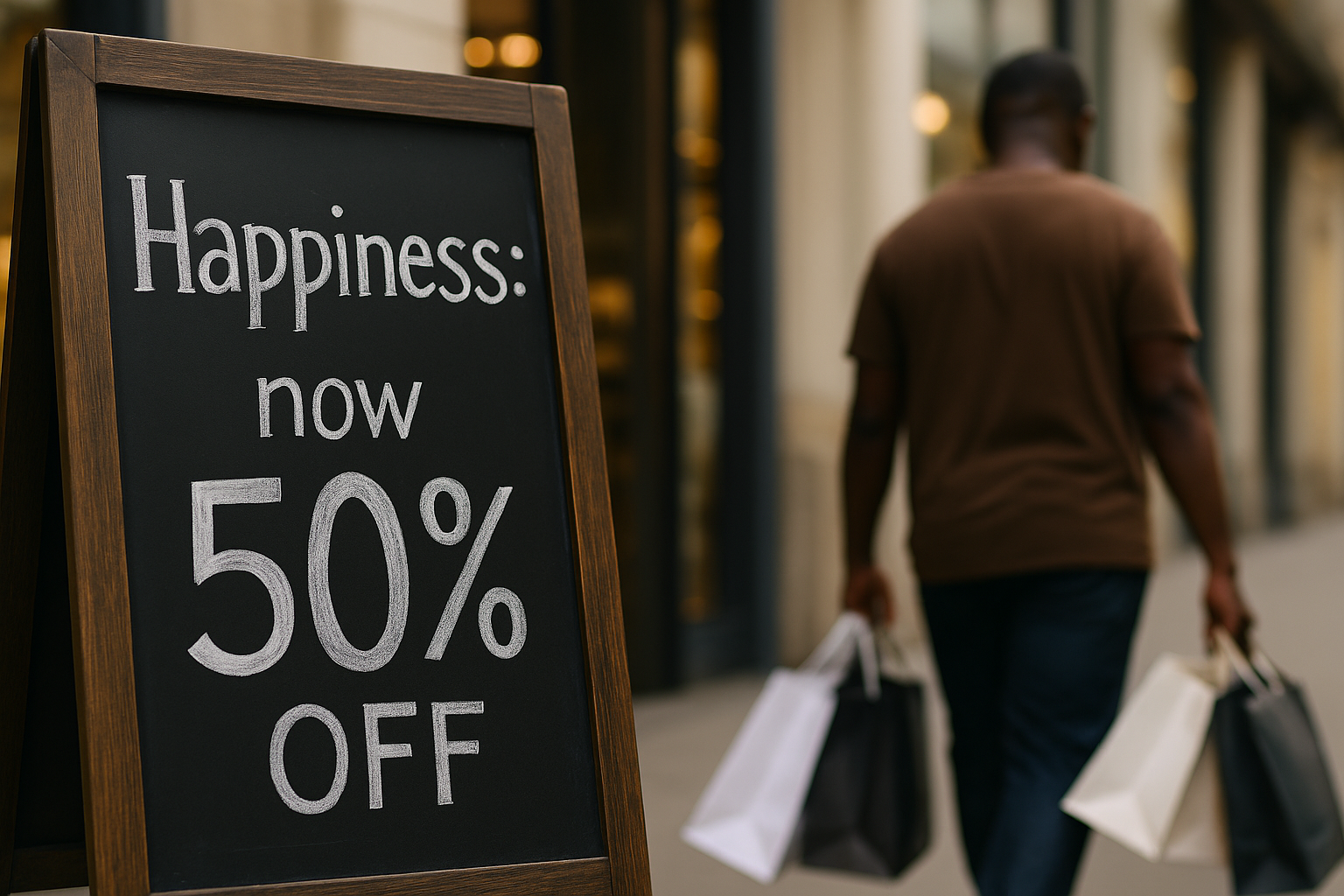
Sadness and shopping in everyday life
Imagine this: you’ve had a rough day — a failed project at work, a fight with a friend, or just one disappointment after another. Later that evening, you find yourself browsing online shops. You didn’t plan to buy anything, but suddenly that new pair of sneakers or fancy candle seems irresistible.
This experience is so common that it has its own name: retail therapy. But is it really therapy? Scientists have been studying the link between sadness and shopping. The surprising answer: sadness and shopping are deeply connected — and researchers have uncovered why.
📌 TL;DR
- Sadness makes people spend more: research shows participants pay up to 30% more when sad.
- The mechanism: sadness increases self-focus and lowers self-worth. Buying restores that sense of value.
- Retail therapy works because making choices gives back a sense of control.
- The effect is specific to sadness, not anger or other negative moods.
- The relief is short-lived — and the bill remains.
Emotions and spending behavior
We like to think money decisions are rational, but in reality, emotions often drive them. Anger, for instance, tends to make people take more risks. Sadness, however, operates differently.
Instead of making us cautious, sadness actually increases our willingness to spend. Researchers call this the “misery is not miserly” effect — in plain English, being sad doesn’t make us tight-fisted; it makes us more willing to part with our money .
Why does this matter in daily life? Because sadness is inevitable — and if it pushes us to loosen our purse strings, it can affect everything from impulse buys after a tough day to bigger financial decisions, like holiday spending when we’re feeling low.
Sadness drives shopping behavior
A study by Cryder and colleagues (2008) tested this directly. Participants watched either a sad film clip (a child losing his mentor) or a neutral nature documentary. Afterwards, they were asked how much money they would spend to buy a simple item — in this case, a sporty water bottle.
The result? Those who had been made sad offered to pay almost four times more than the neutral group. That’s a huge difference for the exact same product.
The researchers dug deeper: why does sadness boost spending? They found that sadness increases self-focus — people use more “I” and “me” language and become preoccupied with their own feelings. This self-focus lowers our sense of self-worth. Buying something new then becomes a quick way to rebuild the self: “If I own this, I feel a little better about myself.”
In real life, that’s why a sad breakup might trigger a shopping spree. It’s not just about distraction — it’s about patching up a wounded sense of self.
Retail therapy and the sense of control
Another team of researchers, Rick and colleagues (2014), took a different angle . They asked: does shopping actually reduce sadness, and if so, why?
In one experiment, participants first watched a sad movie scene. Then, some were asked to choose products they would hypothetically buy, while others were only asked to browse and judge which items were useful. Both groups saw the same products, but only one group had real choice.
The finding was striking: those who got to choose reported significantly less residual sadness than those who only browsed. It wasn’t the distraction of looking at products that mattered — it was the act of choosing.
In a second experiment with real money and products, the effect was replicated. Making shopping choices reduced sadness because it restored a sense of personal control. Sadness often comes with the feeling that life is out of our hands; shopping flips that by letting us decide.
This is why retail therapy feels real in everyday life. After a sad day, buying something new can feel like reclaiming control in a world that suddenly felt uncertain.
Why sadness and shopping are linked
Put together, the studies show two mechanisms that explain why sadness and shopping are so closely connected:
- ✅ Restoring the self: Sadness + self-focus lowers self-worth. Buying things helps rebuild it.
- ✅ Restoring control: Sadness makes us feel powerless. Shopping gives back a sense of autonomy through choice.
These mechanisms make sadness unique. Anger, for example, is also unpleasant, but it comes with blame toward others. Shopping doesn’t fix that, because no amount of purchasing restores justice. (Unless, perhaps, you’re shopping with the creditcard of your cheating ex…) That’s why retail therapy works for sadness, but not for other negative moods.
So.. is retail therapy real therapy?
So, does retail therapy work? Yes — but only for a short while. Buying something can genuinely lift sadness by restoring control and boosting self-worth. That’s why so many people report feeling better after shopping.
But there’s a catch: the relief fades quickly. The underlying sadness remains, and the purchase can bring new problems — from guilt to financial stress. Retail therapy is a band-aid, not a cure.
In real life, this means we should be mindful. Shopping when sad isn’t “bad” in itself — but relying on it as a coping strategy can backfire.
Conclusion: a temporary fix, not a cure
The science is clear: sadness and shopping are linked. Sadness makes us spend more, and shopping can temporarily restore control and self-worth. But the effect is fleeting.
In part two of this series, we’ll look at healthier and longer-lasting ways to deal with sadness — strategies that don’t depend on your credit card.
📚 References
- Cryder, C. E., Lerner, J. S., Gross, J. J., & Dahl, R. E. (2008). Misery is not miserly: sad and self-focused individuals spend more. Psychological science, 19(6), 525–530. https://doi.org/10.1111/j.1467-9280.2008.02118.x
- Rick et al (2014). The benefits of retail therapy: Making purchase decisions reduces residual sadness. Journal of Consumer Psychology, 24(3), 373–380. https://doi.org/10.1016/j.jcps.2013.12.004
🔗 Related articles on the Behavioral Times
- How can you close the gap between wanting and doing? (The intention–behavior gap)
- How hurry undermines kindness in real life